How to Write a Property Description That Attracts Buyers
A step-by-step method for writing clear, credible property descriptions that answer buyer questions and generate better enquiries.
A step-by-step method for writing clear, credible property descriptions that answer buyer questions and generate better enquiries.
Publishing a property online is easy; publishing it well is harder. The difference is not the number of portals you use, but the quality of the information, the accuracy of the listing, and the speed with which you answer serious enquiries. A useful listing should help a buyer or tenant decide whether the property fits before they contact you. That reduces wasted calls and improves the quality of every conversation.
Start with the buyer’s decision
Describe the property around the questions a serious buyer or tenant will ask: exact area, practical layout, condition, floor, access, light, heating or cooling, parking, outdoor space, monthly costs, and realistic availability. Avoid empty claims such as luxury, unique, or perfect unless the listing explains what makes the claim true. Specific information builds trust and also helps search engines understand the page.
Prepare accurate facts before publishing
Collect ownership details, measurements, recent utility information, building charges, renovation dates, energy information where required, and a complete list of included items. Check every number before it goes online. Conflicting prices, different floor areas, or an incorrect map pin create suspicion and produce poor leads. Accuracy is also important when the same property appears on several portals.
Use photographs that explain the space
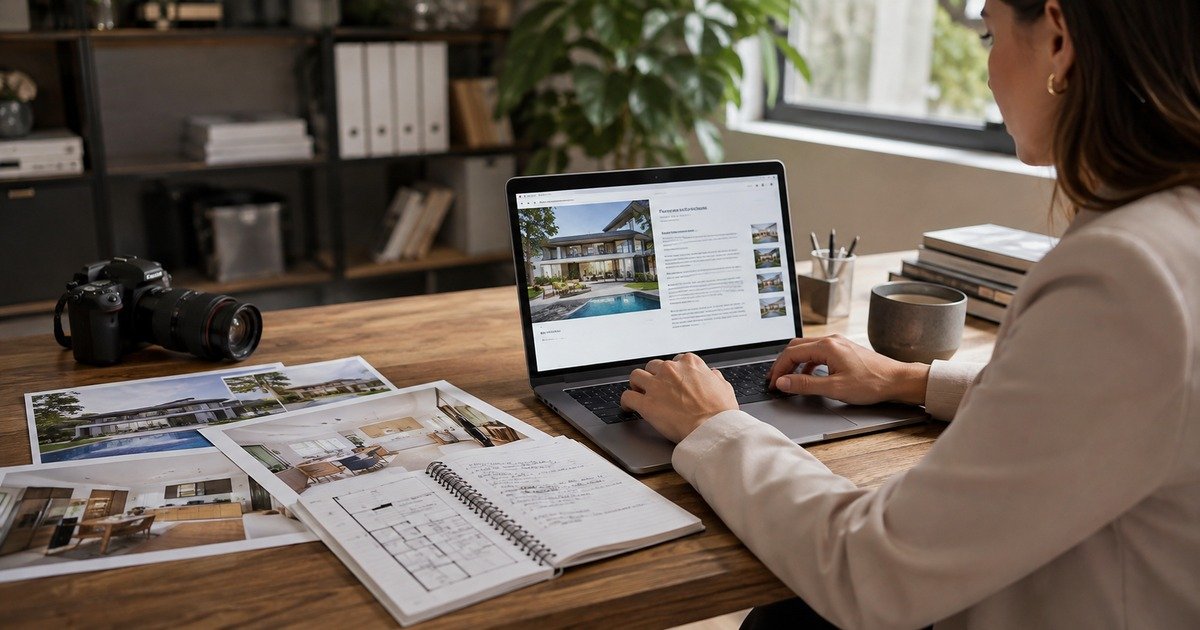
Photographs should show the sequence of the property, not only its most attractive corner. Include the exterior, entrance, main living area, kitchen, bedrooms, bathrooms, storage, balcony or garden, view, parking, and any material defect a viewer should know about. Use daylight, keep vertical lines straight, remove clutter, and avoid filters that change colours or make rooms look larger than they are.
Use a reliable description structure
A useful order is: factual opening summary, layout and condition, strongest features, building or land details, location and transport, costs, legal or availability notes, and a clear viewing call to action. Use the focus phrase naturally in the title, opening, one heading, and conclusion rather than repeating it in every paragraph.
Show, then qualify
Replace ‘spacious living room’ with an approximate area, orientation, windows, and how it connects to the kitchen or terrace. Replace ‘excellent location’ with walking times to transport, schools, shops, or the waterfront. Concrete details help people compare properties and reduce arguments about what marketing words mean.
Write for clarity, not for hype
Use a direct title and a structured description. Open with the strongest verifiable facts, then explain layout, condition, location, costs, and viewing arrangements. Short paragraphs and descriptive headings make the listing easier to scan. Mention limitations honestly. A fourth-floor apartment without a lift may receive fewer clicks, but hiding that fact wastes time and damages trust later.
Choose distribution carefully
A free listing is valuable when the portal reaches the right audience and lets you control the information. Compare geographic reach, search filters, image quality, lead delivery, editing tools, duplicate handling, analytics, and whether the portal forces paid upgrades before the listing becomes visible. A smaller relevant audience can outperform a large general audience.
Respond and improve
Treat publication as the start of the process. Track views, saves, enquiries, viewing requests, and the questions people repeatedly ask. If the listing receives views but no enquiries, revisit price, photographs, and missing details. If it receives enquiries from the wrong audience, improve the title and filters. Fast, complete replies are part of the listing’s performance, not a separate task.
Practical checklist for how to write a property description
- Define the goal and the next decision.
- Collect and verify the relevant facts and documents.
- Use accurate images, pricing, location, and descriptions.
- Keep important promises and calculations in writing.
- Track enquiries, questions, costs, and follow-up actions.
- Use independent professional advice for legal and technical risk.
Frequently asked questions
Does a longer article automatically rank better?
No. Length is only a quality-control floor. Search performance depends on relevance, originality, clarity, authority, technical accessibility, links, and whether the page satisfies the user’s intent.
Should I rely only on information found online?
No. Online guidance is useful for planning, but legal, tax, financing, and technical decisions should be confirmed with qualified professionals in the location of the property.
How can EasyM2 help?
EasyM2 lets users search and publish property listings, while agencies can use EasyStartCRM to manage properties, buyers, leads, follow-ups, and matching in one connected workflow.
How to review the result
Review the page as a user who has no background information. The title should explain the promise, the opening should answer the main question, headings should make the process easy to scan, and every recommendation should lead to a practical action. Remove repetition, unsupported claims, and generic filler. Update figures and regulations when they change, and record the review date so readers can judge freshness.
Keep the information current
Property information loses value when it becomes stale. Review the article, linked listings, prices, regulations, contact details, and location references on a regular schedule. Add a visible update date when material facts change. Remove claims that can no longer be verified and replace broad estimates with current local evidence whenever reliable data becomes available. A smaller library of maintained guides is more useful than a large archive that quietly becomes inaccurate.
Conclusion
How to Write a Property Description That Attracts Buyers is not about completing a checklist mechanically. It is about creating a reliable decision process. Clear information, verified documents, realistic costs, honest presentation, and timely follow-up reduce risk for everyone involved. Use EasyM2 to discover or publish relevant property opportunities, and use EasyStartCRM when a structured agency workflow is needed.