Houses for Sale in Auckland: Finding the Right Home
At a glance (October 2026): To choose among houses for sale in Auckland, compare genuine sales in the same suburb and dwelling type, then inspect…
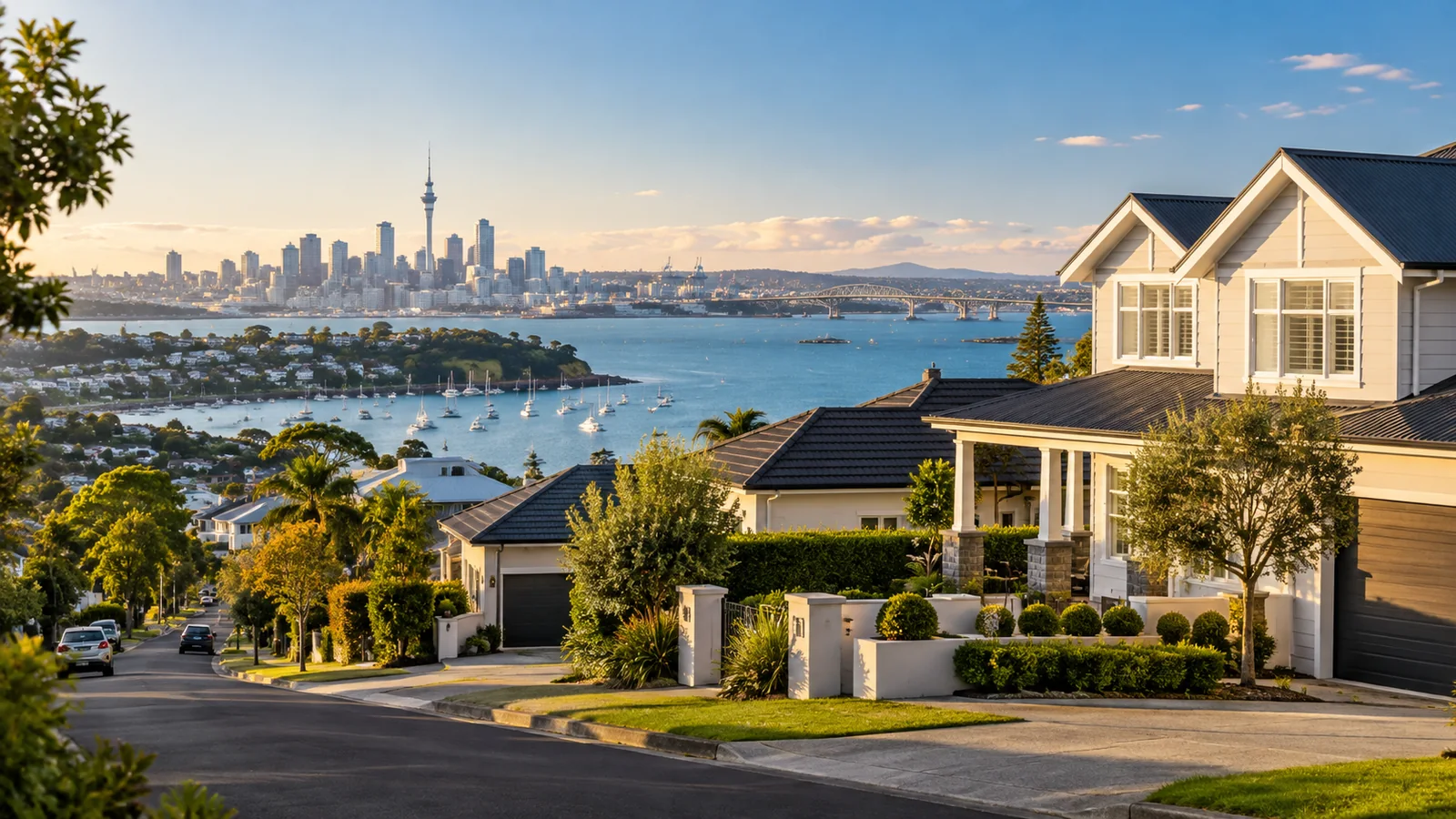
At a glance (October 2026): To choose among houses for sale in Auckland, compare genuine sales in the same suburb and dwelling type, then inspect flooding, slopes, insurance, title structure and commute. A low advertised price can be misleading if a home needs drainage work or has costly shared-property obligations.
Searching for houses for sale in Auckland means navigating a city of strikingly different neighbourhoods, densities and commuting patterns. A standalone house on a quiet street, a terrace home near a train station and a coastal property can all be marketed as Auckland homes, but their ownership obligations and daily convenience are not equivalent. The best shortlist begins with how you intend to live, rather than a citywide ranking of suburbs.
Auckland is New Zealand's largest urban centre. Statistics New Zealand estimated the Auckland region's population at about 1.84 million in June 2026. That scale supports extensive employment and education options, but it also makes journeys across town a meaningful part of any property choice.
Understand Auckland's main housing choices
Established suburbs with detached houses
Areas such as Mount Eden, Epsom, Onehunga and parts of the North Shore include substantial established housing. Buyers may find larger sites, mature trees and traditional layouts, but should examine roof age, drainage, insulation, moisture control and the legality of past alterations. Character can be attractive without guaranteeing low maintenance.
Townhouses and medium-density developments
Terraced housing and newer townhouses appear in many parts of Auckland, including city-fringe locations and established residential areas. These can suit people who value location over a large garden. Ask about sound transmission, storage, parking, outdoor privacy, title structure and any residents' society or shared-facility obligations. A low-maintenance promise should be supported by construction details and actual ongoing charges.
Outer-suburban family homes
Albany, Flat Bush, parts of West Auckland and southern growth areas present different combinations of newer homes, established streets and family facilities. Evaluate school enrolment zones directly with the relevant school, and check whether the property is actually within the stated zone; boundaries and enrolment policies can change. Consider motorway and public transport alternatives, especially if two household members commute in opposite directions.
How to compare Auckland neighbourhoods
Rather than choosing by postcode alone, build a personal scorecard. Measure the morning and evening commute, access to shops and healthcare, outdoor space, noise at night, property condition and transport alternatives. Harbour crossings, motorway congestion and local terrain can change travel reliability. If possible, visit a candidate property on a weekday and after heavy rainfall, not only during a sunny Sunday open home.
Schools and parks are important to many buyers, but proximity is not the same as legal entitlement to a particular school. Ask about future construction on neighbouring sites, bus routes and parking rules. For waterfront and low-lying properties, natural hazard investigation deserves as much attention as the view.
Budget beyond the advertised price
An asking price is a marketing signal; recent comparable sales are better evidence of what buyers have actually paid. Compare sold properties with similar land area, house condition, title and location. A renovated bungalow cannot be priced sensibly against an unrenovated property using bedroom count alone. Similarly, a new-build townhouse may carry different maintenance risk but less private land.
Calculate the full cost of ownership. Include legal fees, building inspection, council rates, home insurance, water and energy bills, commuting costs and money for repairs. If finance is needed, test the mortgage against a rate increase or temporary income disruption. A larger home farther away may be less affordable once the household's transport costs are included.
Auckland-specific due diligence
Flooding, stormwater and slope
Flood exposure is property-specific. Review Auckland Council hazard information, the LIM and any relevant property files, and seek expert advice for sites near waterways, on steep terrain or with significant retaining walls. Ask whether flooding, subsidence or stormwater problems have previously affected the dwelling. An independent building inspector may identify signs of unresolved moisture damage.
Title, access and unconsented work
Obtain the current Record of Title. Cross-leases, easements, shared driveways and covenants can limit extensions, parking or use. Match the building layout against council documentation and ask about any decks, bathrooms or conversions added without appropriate approval. Your lawyer should explain anything unusual before an offer becomes unconditional.
House condition and insurance
Even apparently renovated homes may conceal ageing plumbing, wiring, water ingress or inadequate underfloor ventilation. Arrange an inspection suited to the building's age and type. Seek an insurance quote early for homes with known natural hazards or complex construction, because difficulty obtaining adequate cover can affect finance and future resale.
A disciplined offer strategy
Once a house meets your practical criteria, request the relevant disclosures and documents. Have a lawyer review the proposed sale and purchase agreement and negotiate suitable conditions where possible. At auction, complete due diligence first and understand that a successful bid is generally unconditional. Decide your ceiling based on evidence and affordability, not competitive pressure at the viewing.
Auckland has many submarkets; the sensible approach is to compare several similar homes within a realistic travel catchment and investigate the individual address thoroughly.
A practical way to shortlist houses in Auckland
Keep one worksheet per property and record the viewing date, asking-price method, tenure, usable indoor area, land area and any unresolved technical questions. After inspecting several homes, the details are easy to confuse. Ask the agent for information in writing and distinguish facts supported by documents from estimates or promotional language. A deliberate comparison also helps prevent an impressive renovation from distracting from an inconvenient layout or costly commute. Before committing, decide which issues are deal-breakers and which are negotiable maintenance expenses.
Compare Auckland homes with a property-by-property scorecard
| Factor | In an established detached-home suburb | In a newer townhouse development |
|---|---|---|
| Outdoor space | Often greater, with more garden upkeep | Often smaller, with simpler upkeep |
| Title and access | Check easements, cross-leases and historic alterations | Check the title, shared access, party walls and any residents' society |
| Building risks | Older roofing, moisture, drainage and extensions | Cladding quality, warranties and original building approvals |
| Everyday convenience | School zone and commuting times vary by street | Transport, parking and storage still need individual verification |
For Auckland hazard research, distinguish a floodplain, flood-prone area and overland flow path. Auckland Council's 2026 flood-mapping explanation describes these as different hazard layers; a mapped path does not automatically show that a home has flooded. Read the underlying information, ask the council relevant questions, and obtain professional advice where risk is material. <https://ourauckland.aucklandcouncil.govt.nz/news/2026/03/understanding-auckland-s-regional-flood-maps/>
Do the commute test during the actual morning or evening peak, and request an insurance indication before an offer becomes unconditional. These two checks can reverse an apparently attractive suburb ranking.
For a related property decision, read Best Auckland Suburbs to Live In: A Lifestyle-Based Property Guide.
An Auckland suburb comparison with real rental context
A suburb's rental evidence does not determine a purchase price, but it reveals how different kinds of homes serve different households. For example, a published summary of government bond-lodgement data for 1 March–31 August 2026 showed these median weekly rents for three-bedroom houses: Mount Eden NZ$780, Onehunga NZ$700 and Mount Roskill NZ$675. That is a difference of NZ$105 a week, or NZ$5,460 a year, between the first and third examples. These figures are historical rents, not house sale prices or current advertised rents; property quality and street location still matter. The underlying indicator is Tenancy Services market rent, and the dated suburb figures are reproduced in this local market summary. Use the official market-rent tool to check the latest period and dwelling type.
| Search area | Housing decision worth testing | Particular trade-off |
|---|---|---|
| Mount Eden | Character detached house versus newer infill | Maintenance, parking and rail/bus access |
| Onehunga | Established house versus compact development | Street noise, services, transport connections |
| Mount Roskill | Family home versus townhouse | Layout, parking and exact school zone |
| Albany | North Shore house versus town-centre apartment | Road access, bus connections and household travel |
| New Lynn | Train-connected compact housing versus older house | Noise, ventilation and site drainage |
A transport change that matters in 2026: Auckland Transport's September 2026 network information lists the East West line serving places including New Lynn, Henderson, Maungawhau and central-city stations; a separate Onehunga West line connects Onehunga with points including Newmarket and New Lynn. Check the exact address-to-work journey using Auckland Transport's Journey Planner, including transfer and walking time, rather than assuming every house within a suburb is near a station. Source: Auckland Transport network maps, updated September 2026.
Auckland property risks: a three-question site investigation
1. Does water move across this site? An overland flow path may cross an otherwise attractive garden or driveway. Start with Auckland's Flood Viewer, then obtain a LIM and arrange specialist advice where necessary. A viewer is screening information, not a substitute for professional site assessment.
2. What will neighbours legally share? Check the title, easements, rights of way, stormwater infrastructure and maintenance obligations. In an infill development, a shared driveway or retaining wall can create costs not visible in the floor plan.
3. What would the home cost after settlement? Obtain an insurance indication before unconditional commitment. Ask for council rates, potential body corporate charges, and actual roof, moisture and drainage condition. A property with a lower price but NZ$35,000 of urgent repairs may be financially less attractive than a sound house priced slightly higher.
The aim is not to declare one Auckland suburb the winner. It is to turn the first 20 search results into three or four genuinely comparable homes, each scored on cost, transport, condition and legal risk.
Frequently asked questions
Which Auckland suburb is best for families?
There is no universal winner. Consider your commute, school requirements, home size, budget and local amenities. Compare candidate streets and verify any school zoning claims independently.
Are Auckland townhouses the same as freehold houses?
Not necessarily. Title arrangements vary, and some involve shared facilities or covenants. Review the Record of Title and relevant agreements with your lawyer.
Should I check flood risk before buying?
Yes. Use relevant council hazard information, a LIM and specialist advice where needed. Flood risk is not reliably determined from an estate agent's photograph.
Can I make an offer conditional on finance and inspection?
Conditions may be negotiated in a standard sale, but their wording matters. Auctions are commonly unconditional. Obtain legal advice before offering or bidding.
What is an overland flow path on an Auckland property?
It is a mapped route surface water may follow during heavy rain. It is not the same as a recorded flood event. Check council mapping and property-specific expert advice before deciding.
Sources and verification
- https://manageforyou.co.nz/property-management-central-auckland/
- https://at.govt.nz/bus-train-ferry/train-services/auckland-train-network-maps
- https://at.govt.nz/bus-train-ferry/how-to-use-the-journey-planner
- Stats NZ population estimates June 2026
- REA home buying and contract guidance
- Settled due diligence
- LINZ records of title
What to do next
Compare similar sold homes on the same side of Auckland, check council hazards and have your lawyer confirm the title before choosing an offer strategy.